

PNTSH
Summary
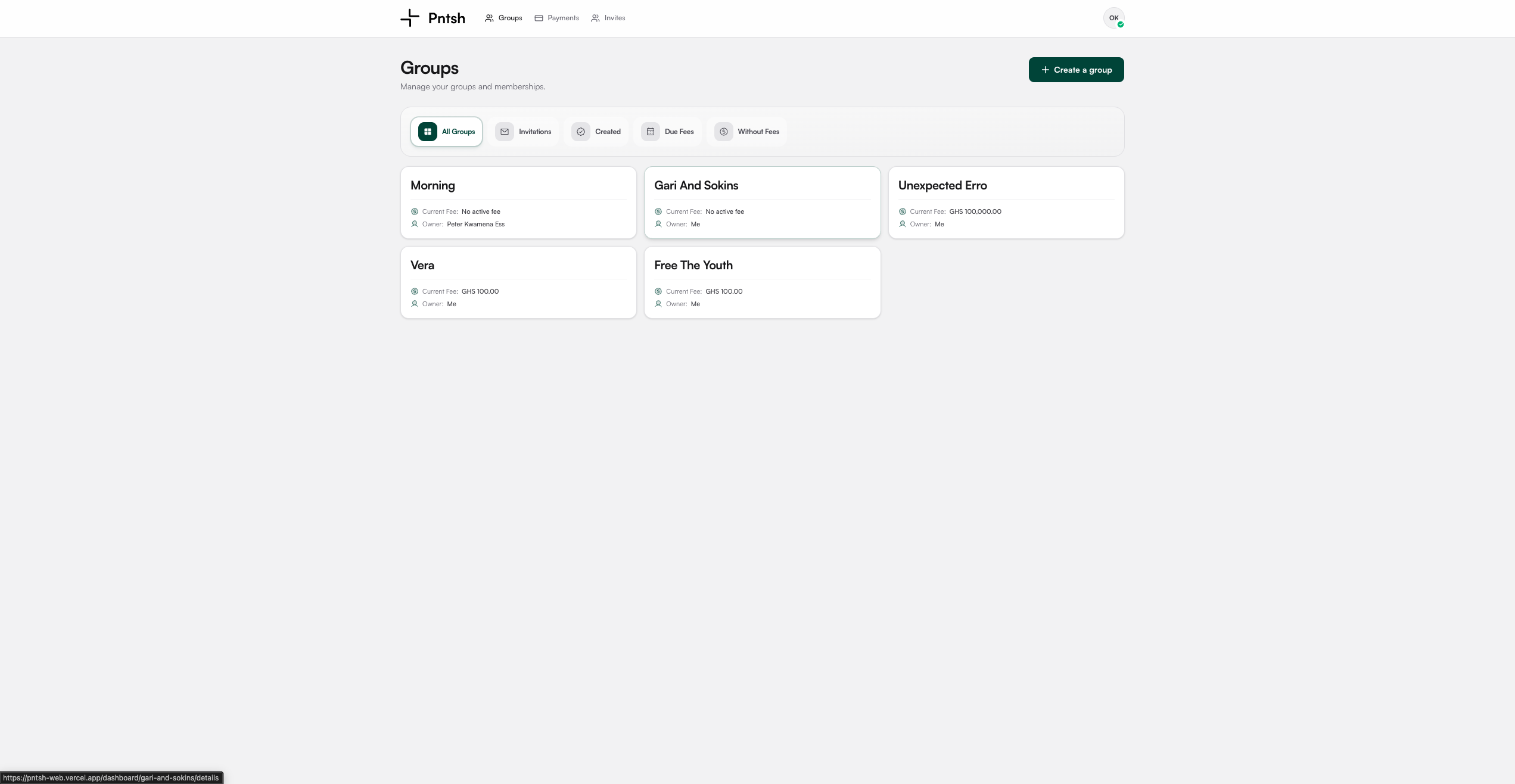
PNTSH is a Laravel 12 API powering a group-based contributions product. It supports group creation and membership, invite flows, fee creation, member payments via Paystack, and owner withdrawals with OTP-verified payout accounts — with notifications delivered via email and push.
Project Snapshot
My Role
Backend Developer
Duration
2026
Context
Backend API Project
Outcome
Group invites + fee payments · Paystack verification webhooks · OTP-verified withdrawals
Stack
The Problem
Context
Group contributions need simple, reliable flows: create a group, invite members, collect payments, and let owners withdraw funds safely — all while keeping accounting accurate.
The Pain
Without strong payment verification, idempotent callbacks, and safe withdrawal controls, financial flows become inconsistent and risky. Small edge cases (duplicate webhooks, partial payments, unverified payout accounts) cause big issues.
Why It Mattered
Payments must be trustworthy and auditable. Users need confidence that their contributions are recorded correctly, and group owners need safe withdrawals with clear checks and balances.
Goals & Requirements
Technical Goals
- Secure auth for mobile clients (Sanctum)
- Group + membership management with ownership controls
- Two invite modes: direct invites and invite links
- Fee creation and tracking (active/closed) with accurate totals
- Payments via Paystack (init + verify + webhook handling)
- Withdrawals via Paystack transfers with OTP verification
- Notifications via email + push (FCM)
- Admin operations via Filament
Constraints
- Design for webhook retries (idempotency)
- Keep accounting updates consistent and transaction-safe
- Treat withdrawals as high-risk actions with extra verification
Architecture Design
A layered Laravel API (routes → controllers → services → Eloquent/MySQL) with dedicated modules for groups, invites, fees, payments, withdrawals, and notifications. Payments and withdrawals integrate with Paystack, payout account verification uses Hubtel SMS OTP, and notifications fan out to email + Firebase FCM.
Scroll horizontally on smaller screens to view full diagram
Component Breakdown
Auth (Laravel Sanctum)
Secures API access for mobile clients and admins.
Groups & Membership
Group creation, membership joins, and ownership permissions.
Invites
Direct invites and invite links for onboarding members into groups.
Fees
Fee lifecycle (create, active/closed) and aggregate totals for collection/withdrawal.
Payments (Paystack)
Initialize and verify fee payments and record durable payment state transitions.
Withdrawals + Payout Accounts
OTP verification for payout accounts and Paystack transfers for withdrawals.
Notification Service
Triggers push notifications (FCM) and email updates for key events.
Admin Panel (Filament)
Operational visibility and moderation of groups, fees, payments, and withdrawals.
MySQL
Primary datastore for users, groups, fees, payments, and withdrawals.
Key Design Decisions
→Service layer for business logic
Keeps controllers thin and concentrates payment/withdrawal rules in testable, reusable services.
→Webhook verification + idempotency mindset
Paystack can retry events; the API must safely handle duplicate callbacks without double-counting payments.
→OTP for withdrawal account verification
Withdrawals are high-risk; requiring OTP via SMS reduces fraud and prevents misdirected payouts.
→Filament for admin tooling
Accelerates internal dashboards and operations without building a separate admin frontend.
Implementation Breakdown
Domain modules and routing
API routes are organized around the product’s core modules (groups, invites, fees, payments, withdrawals).
- Clear REST endpoints for group lifecycle and membership
- Separate flows for direct invites vs invite links
- Admin routes exposed via Filament
View diagram source
flowchart TB
    subgraph LaravelAPI[Laravel API]
      auth[Auth & Sanctum]
      groups[Groups & Membership]
      invites[Invites/Invite Links]
      fees[Group Fees]
      payments[Payments]
      withdrawals[Withdrawals]
      notify[Notification Service]
      adminc[Admin/Filament Modules]
    end

    db[(MySQL)]
    paystack[Paystack]
    hubtel[Hubtel SMS]
    fcm[Firebase]
    mail[SMTP]

    auth --> db
    groups --> db
    invites --> db
    fees --> db
    payments --> db
    withdrawals --> db
    adminc --> db

    payments --> paystack
    withdrawals --> paystack
    withdrawals --> hubtel
    notify --> fcm
notify --> mailPayments: init → verify → finalize
Payments are created as PENDING, verified against Paystack, then finalized with consistent DB updates.
- Store Paystack reference per payment
- Verify on callback/webhook before marking SUCCESS
- Update fee totals after successful verification
View diagram source
sequenceDiagram
    participant U as User (Member)
    participant API as Laravel API
    participant Pay as Paystack
    participant DB as Database
    participant O as Group Owner

    U->>API: POST /groups/{groupId}/fees/{feeId}/pay
    API->>DB: Create/Update payment (PENDING, reference)
    API->>Pay: Initialize transaction
    Pay-->>API: authorization_url
    API-->>U: payment link/reference

    Pay-->>API: Webhook charge.success
    API->>Pay: Verify transaction
    Pay-->>API: success
    API->>DB: Update payment=SUCCESS, paid_at
    API->>DB: Update fee totals (total_collected, total_paid_members)

    O->>API: POST /withdrawal/request-otp
    API->>O: OTP sent (Hubtel SMS)

    O->>API: POST /withdrawal/verify-otp
    API->>Pay: Create transfer recipient
    API->>DB: Save withdrawal_account(recipient_code)

    O->>API: POST /group/{groupId}/fee/{feeId}/withdraw-funds
    API->>DB: Validate owner, closed fee, available amount
    API->>Pay: Transfer funds
    Pay-->>API: transfer reference/status
    API->>DB: Insert group_withdrawals
    API->>DB: Increment group_fees.total_withdrawn (on success)
API-->>O: Withdrawal resultWithdrawals with safety checks
Withdrawals validate ownership, fee closure rules, and available balance before initiating a transfer.
- OTP-verifies payout account before enabling withdrawals
- Records group_withdrawals and updates total_withdrawn
- Rejects withdrawals when fee is not closed or balance is insufficient
Notifications
Event-driven notifications keep members informed about invites, fees, payments, and withdrawals.
- Push notifications via Firebase FCM
- Email notifications via Laravel Mail
Challenges & Solutions
#1Preventing double-counted payments
The Problem
Payment providers may send duplicate webhooks, and users may retry checkout. Without protections, totals can drift.
The Fix
Model payments as a state machine (PENDING → SUCCESS/FAILED) and verify against Paystack before finalizing. Treat webhook handling as idempotent and only apply fee total updates once per reference.
#2Withdrawal safety and verification
The Problem
Allowing withdrawals without strong verification can lead to misdirected funds or fraud.
The Fix
Require OTP verification (Hubtel SMS) to create/activate a payout recipient, then perform Paystack transfers only for verified accounts.
Results & Impact
A complete backend foundation for group contributions with reliable payment verification and safe withdrawal flows.
Before → After
Payment verification
Withdrawal safety
Operations
Business Outcome
Members can pay fees confidently, owners can withdraw safely, and admins can monitor activity with clear records for support and auditing.
Reflections
Would Do Differently
- 01Add explicit idempotency keys and DB-level uniqueness constraints for provider references
- 02Expand automated tests around webhook edge cases and partial failures
Key Takeaways
- 01In payment systems, correctness beats cleverness — verify, record, and reconcile
- 02Withdrawals deserve a higher security bar than deposits
Next Project
Event-Crypt
Full-Stack Engineering